

Dubai AI Group™ Research
State of Dubai 2026: Economy, AI, Infrastructure and Institutional Capacity
A detailed 2026 assessment of Dubai’s economy, AI adoption, investment environment, financial infrastructure, institutional capacity, and technology-led development model.
- Publication
- Research Paper
- Topic
- Dubai / Economy
- Published
- Reading time
- 6 min
- Institution
- Dubai AI Group™
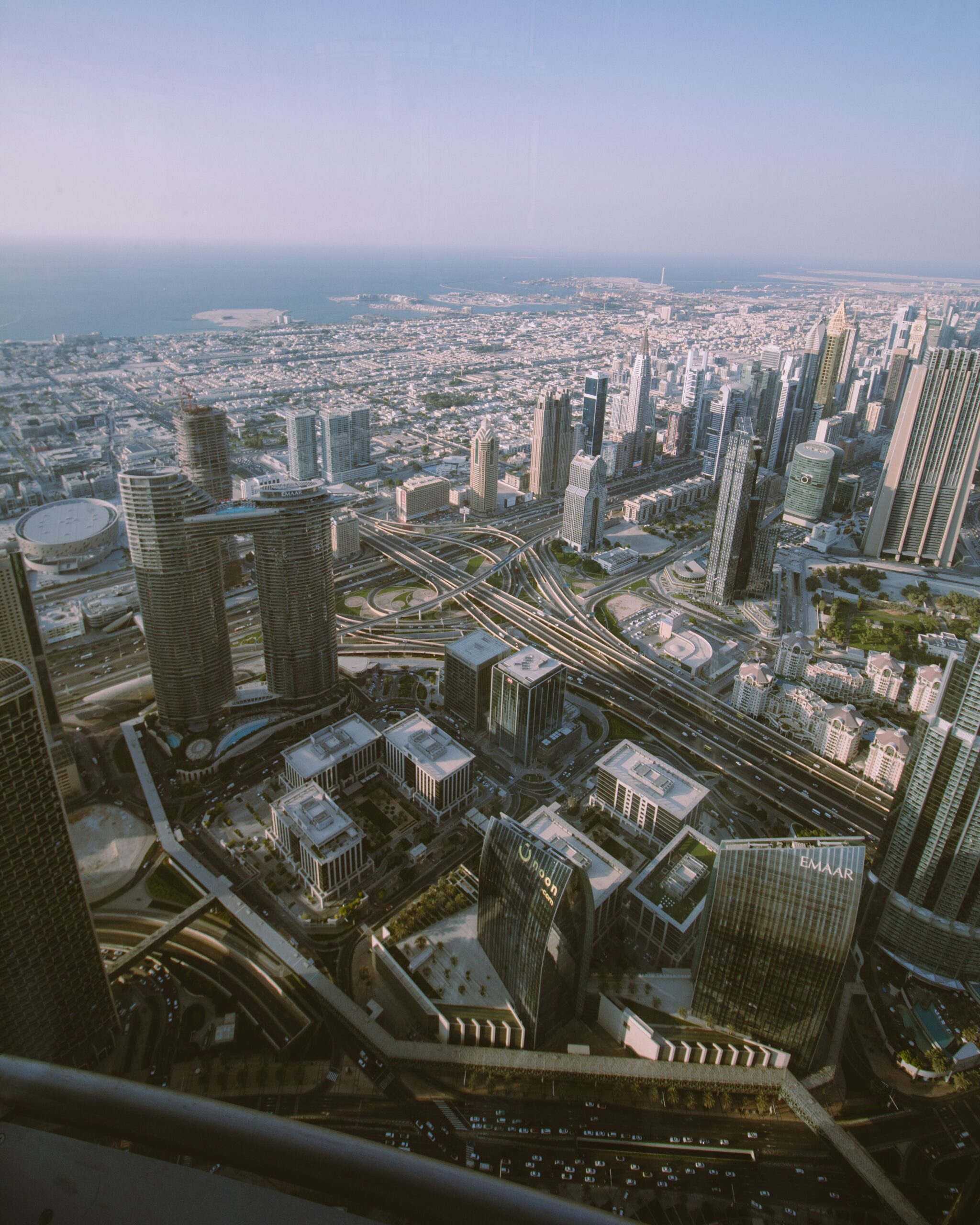
Dubai enters the final quarter of 2026 with a resilient, increasingly technology-intensive economy and a development model built around capital formation, infrastructure, institutional speed, global connectivity, and artificial intelligence. The central question is no longer whether Dubai can attract growth. It is how effectively the city can convert investment, data, talent, and emerging technology into durable productivity and globally relevant institutions.
Dubai AI Group Research · September 2026
Executive perspective
The state of Dubai in 2026 is best understood as a convergence of several systems: a diversified economy, a deepening financial centre, global foreign-direct-investment leadership, rapid AI adoption, large-scale infrastructure expansion, and a policy environment designed to move new technologies into operational use. These systems reinforce one another. Capital attracts companies and talent; infrastructure expands capacity; institutional frameworks reduce friction; technology improves productivity; and global connectivity broadens the market available to firms operating from Dubai.
Dubai’s Q1 2026 GDP reached AED232 billion, up 2.4% year on year, according to the Government of Dubai Media Office. The significance of that figure is less the headline growth rate than the breadth of the operating model beneath it: trade, finance, transport, tourism, real estate, professional services, digital infrastructure, and emerging technology are increasingly interconnected.
1. A diversified economy remains the foundation
Dubai’s economic resilience continues to depend on diversification rather than a single dominant sector. The city combines financial services, trade and logistics, tourism, aviation, real estate, professional services, technology, manufacturing, and creative industries within one globally connected operating environment.
The 2026 GDP data reinforce this model. Government commentary accompanying the Q1 figures emphasized adaptability, data-driven decision-making, institutional capability, government efficiency, and the use of modern technologies as economic enablers. That is important because the next phase of growth is likely to come less from adding isolated sectors and more from increasing productivity across existing ones.
2. Dubai remains a global magnet for greenfield investment
Dubai retained the world’s No.1 position for greenfield FDI projects for the fifth consecutive year based on 2025 results published in 2026. It also remained No.1 globally for headquarters greenfield projects and for AI-related greenfield FDI projects. The city ranked first across multiple strategic clusters including ICT and electronics, professional services, financial services, life sciences, environmental technology, transportation and warehousing, and—newly—manufacturing projects.
This matters because greenfield investment creates more than capital inflow. It creates local operating capacity: offices, research teams, engineering functions, supplier relationships, infrastructure demand, employment, and regional headquarters. For an AI economy, that physical and organizational presence is especially important.
3. Finance is becoming a technology platform
Dubai International Financial Centre is one of the clearest indicators of Dubai’s institutional scale. By the end of H1 2026, DIFC reported 10,018 active registered companies, including 1,933 AI, FinTech, and innovation companies. The Centre also announced its ambition to become the world’s first AI-native financial centre, embedding AI across regulation, business operations, talent development, infrastructure, and the physical district.
The shift is strategically important. Financial centres traditionally provide legal certainty, capital access, talent concentration, professional services, and network density. An AI-native financial centre adds another layer: machine-readable governance, intelligent compliance, agentic workflows, AI-enabled service delivery, and potentially new operating models for regulated institutions.
4. The infrastructure layer is expanding
Dubai’s 2026 investment cycle includes large-scale physical and digital infrastructure. The planned DIFC Zabeel District carries an estimated gross development value exceeding AED100 billion and is designed to more than double DIFC’s capacity, with over one million square feet dedicated to future technologies and AI.
Dubai Silicon Oasis is also expanding through projects including District IO, an AED11 billion development focused on future technology sectors including artificial intelligence, quantum computing, robotics, smart mobility, 3D printing, Web3, and related R&D. Official projections associate District IO with up to AED30 billion in FDI by 2036 and a substantial long-term GDP contribution.
These projects show that Dubai is treating innovation capacity as infrastructure rather than simply as startup programming. The physical environment—labs, offices, compute access, campuses, training capacity, transport, housing, and convening space—becomes part of the innovation system.
5. AI moves from initiative to operating layer
Dubai’s AI trajectory in 2026 is increasingly operational. Government initiatives are moving toward agentic systems, private-sector transformation, workforce development, data governance, AI-enabled permits, and AI-native financial infrastructure.
The private-sector agentic-AI initiative announced in May 2026 is particularly notable because it targets organizational transformation rather than isolated experimentation. Training tracks, incubators, and dedicated funding mechanisms indicate an attempt to build both demand and supply around autonomous AI systems.
The implication for enterprises is clear: AI adoption is becoming less about procuring a model and more about redesigning workflows, permissions, data access, identity, controls, audit evidence, and human oversight.
6. Institutional capacity is a competitive advantage
Dubai’s competitive model depends heavily on institutional execution. Economic zones, licensing systems, digital government, financial regulation, data infrastructure, immigration frameworks, transport, aviation, and real-estate development all shape how quickly firms can establish and scale operations.
In the AI era, that execution advantage extends into governance. Organizations need rules for model use, agent identity, data access, automated decisions, cybersecurity, evidence, and accountability. Jurisdictions that can provide clear, interoperable, and commercially practical frameworks may have an advantage in attracting enterprises that want to deploy advanced systems without sacrificing control.
7. Talent and capital are increasingly linked
The next stage of Dubai’s technology economy will depend on whether the city can retain and deepen specialist capability—not only attract companies. AI engineering, cybersecurity, data architecture, semiconductor and compute expertise, robotics, quantum research, governance, and enterprise transformation all require experienced technical and institutional talent.
Capital and talent reinforce each other. A stronger venture and private-capital ecosystem gives technical founders more reasons to build locally; deeper technical capability gives investors more investable companies; and large enterprises create demand for applied innovation beyond early-stage startups.
8. Constraints and strategic risks
Dubai’s momentum does not eliminate execution risk. Fast adoption can create fragmented technology estates, duplicated platforms, unclear AI accountability, cybersecurity exposure, talent bottlenecks, speculative capital allocation, and dependence on external infrastructure or model providers.
There is also a measurement challenge. Announced investment, projected economic value, registered companies, and deployed production systems are different indicators. A mature technology economy should distinguish between pipeline, capital committed, systems deployed, productivity achieved, and enduring enterprise capability.
2026 outlook
Dubai’s strongest position in 2026 is not any single technology or ranking. It is the combination of capital, connectivity, institutions, infrastructure, and willingness to operationalize emerging technology.
The next phase will be judged by conversion: whether the city can turn investment into productive companies, AI adoption into measurable operating gains, infrastructure into research and commercialization, and global visibility into durable intellectual and institutional capacity.
If that conversion continues, Dubai is positioned not only as a place where technology companies establish regional offices, but as a market where new operating models for AI, finance, advanced infrastructure, and institutional technology are developed and tested at scale.
Research references
- Government of Dubai Media Office — Dubai GDP reaches AED232 billion in Q1 2026
- Government of Dubai Media Office — Dubai ranks No.1 globally for greenfield FDI projects for fifth consecutive year
- DIFC — H1 2026 industry-leading achievements
- Government of Dubai Media Office — AED100 billion DIFC Zabeel District expansion
- Government of Dubai Media Office — Dubai Silicon Oasis strategic expansion and District IO
- Government of Dubai Media Office — Private-sector transition toward Agentic AI
Research notice
Dubai AI Group™ research is provided for general informational and research purposes and does not constitute legal, regulatory, investment, cybersecurity, or other professional advice.
Research focus
Dubai / Economy · enterprise artificial intelligence · governance · infrastructure · intelligent systems
Continue exploring
Research on the systems shaping enterprise AI.
Dubai Investment Outlook 2026: Capital, FDI and the AI Economy
A detailed outlook on Dubai’s 2026 investment landscape across FDI, finance, private capital, AI, advanced infrastructure, venture funding, and technology…

AGI Prediction 2026: Scenarios for the Next Intelligence Threshold
A scenario-based 2026 research outlook on artificial general intelligence, capability thresholds, uncertainty, governance, and enterprise preparation through 2030.

Agentic AI in 2026: From Copilots to Governed Execution
Research on agentic AI, enterprise execution, agent identity, permissions, audit trails, control planes, and the governance required for autonomous systems.